Have you ever noticed the way an orchid discards old leaves? It's as if they have built in obsolescence!
Basically, the leaf base has a line across it which is barely noticeable all the time the leaf is alive, well and doing its job for the plant. However, as the leaf grows older and starts to grow brown, this line gradually becomes more noticeable. It slowly but surely cuts the old leaf off from the rest of the plant, staying there until the old leave can just separate from the body of the plant and drop off by itself. It leaves an already sealed and invulnerable 'wound' where the line was.
I've been keeping orchids for quite a long time, and have noticed this fascinating behaviour. If I see a brown leaf, I'll occasionally give it a gentle tug. For ages, nothing will come of the tug, until one day, the whole leaf just comes cleanly off in my fingers. It leaves behind a tidy base, all neat and pre-healed.
It's amazing. Presumably this is what's happening all around me in the autumn when the trees drop their leaves too … but I was never conscious of it until I kept orchids.
You may be at a time in your life when you're clearing out relationships that no longer serve you, or perhaps you're making other significant changes. I put it to you that discarding like an orchid is a jolly good way of going about it! Let it stay in situ as it gradually dies away. Stop taking from it, stop feeding it. You can adjust, the person or thing you're discarding can adjust, and when the time comes, it can happen naturally with no damage done. The discarded leaf can become your compost to feed new growth.
Wednesday, 19 February 2020
Thursday, 7 November 2013
Tagxedo 2013
ChristmasLunchAtOurs
Pilates
Yoga
KarenAndMark
JackDee
SoundOfSoulChoir
TurinBrakes
TheBlackAlbum
GranCanaria
PuertoLasNieves
Firgas
Othello
TakingFolaToHastings
BrightonUniversity
Abduls
SilentDisco
WendysDiagnosis
Reiki
StephenAndLynda
ManOfSteel
ColdPlace
Sally
TheWorldsEnd
JillAndJulie
PeterAndAlan
Lisa
Vicky
KateAndRachel
PokerNight
TheNewsroom
Scandal
HazelsSeventiethParty
TheJetty
BreatheIn
Charlene
WendyAndGordon
ScrabbleNight
SeanLock
MarkVanessaAndFreya
PerkinMovesToWorthing
TheIceman
BehindTh Candelabra
Wimbledon
TheGrea Gatsby
ForestSpice
I'mSoExcited
OurChildren
TheEyeOfTheStorm
Mud
TheFrenchOpen
Paris
Fola'sBraces
AHijacking
TessAtMonkeyWorld
LoveIsAllYouNeed
ReikiSharing
ThisHouse
ClareSummerskill
InTheHouse
Trance
ThePaperboy
IsleOfSkye
Bruchlas
KinlochLodge
TheThreeChimneys
Argo
KohThai
No
Funnybone
ComedyClub
ThisisForty
IanVisits
OlaVolunteering
PavilionDance
TheLighthouse
RunThisTown
Bullhead
MovingHouse
Removals
FlatSixSurreyLodge
Bournemouth
BournemouthGardens
Beach
CircularWalks
Lincoln
TheSessions
DjangoUnchained
ThirtyCecilStreet
TheImpossible
Quartet
LoveCrime
MidnightsChildren
LifeOfPi
IAnna
BBCInterviews
SevenPsychopaths
TessThirdBirthdayParty
Nativ
GreatExpectations
ViewingFlats
TwoThousandAndThirteen
Sunday, 22 July 2012
Tuesday, 22 May 2012
Duck Eggs
For the last couple of days, I've been driving up and down the Dorset and Wiltshire countryside. My route takes me past several places selling free range eggs direct.
I'd asked my partner a while ago if she'd like to try duck eggs. I've never had them and wondered what they'd be like. She said she didn't fancy the idea so I didn't push it. However, today the farm shop I stopped at also had duck eggs so I decided to try them. They were pretty huge with very white delicate looking shells.
I'd forgotten to take anything out of the freezer for tea so had the perfect reason to experiment with the eggs. A bit of internet research revealed that the taste was a little richer than hens' eggs because both the white and the yolk are higher in protein. Apparently they're excellent for baking really light sponges as they're able to hold a lot of air bubbles when beaten. Also, their richness works especially well with home-baked biscuits.
Anyway, baking wasn't on the cards tonight as time was limited and what I was short of was a main course.
I had some chorizo in the fridge, and some fresh local asparagus. So, one chopped onion, one chopped red pepper, thickly diced chorizo, asparagus cut into inch long segments, all lightly fried together with a bit of olive oil. I added in one oxo cube, a bit of salt, a sprinkle of smoked paprika and a pinch or two of dried red chilli. When all that was cooked, I poured in the beaten egg and kept the whole thing moving (I wanted the egg scrambled rather than set). The duck eggs cooked much more quickly than hen eggs.
The result? Yum! The egg was nice and yellow, and stood up very well to the rich flavours I'd teamed them with. Even my step-son, who isn't at all keen on eggs, was enthusiastic.
I didn't dare mention that they were eating duck eggs or they would have probably made a fuss! It'll be a good test of whether or not they read my blog!
Sunday, 26 February 2012
Beautiful Beads
Last summer I spied a necklace on someone that I really liked the look of. I took a mental picture of it and decided that it couldn't be beyond my wit to make my own version of it. I did a bit of internet research and discovered that I could buy a beginners' bead making kit on eBay for less than £15. This included a booklet, the necessary tools, and a variety of equipment (including beads) to get me on my way.
I had a go and found that it wasn't too difficult to make a pair of simple drop earrings. However, I didn't like the beads in the kit enough to want to try and make a necklace out of them. Luckily for me, there's a bead shop on Poole High Street near The Quay, so I hot-footed it to there one lunchtime and had great fun choosing lots of colourful glass beads. I took the kit and the beads on holiday with me and came up with my first creation.
More recently, I bought a black and red dress which I didn't have any jewellery to go with. I wanted something a bit lighter than my first piece, so decided to create a more 'floating' design. The beads for this one cost me just over £5 (and I have lots of the smaller ones left over for something else).
There are lots of bead suppliers online if there isn't a shop near you, and the designs are limited only by your imagination. You can make something that goes perfectly with your outfit, and at a length to suit you. It really is quite easy to make something eye-catching and unique.
I had a go and found that it wasn't too difficult to make a pair of simple drop earrings. However, I didn't like the beads in the kit enough to want to try and make a necklace out of them. Luckily for me, there's a bead shop on Poole High Street near The Quay, so I hot-footed it to there one lunchtime and had great fun choosing lots of colourful glass beads. I took the kit and the beads on holiday with me and came up with my first creation.
More recently, I bought a black and red dress which I didn't have any jewellery to go with. I wanted something a bit lighter than my first piece, so decided to create a more 'floating' design. The beads for this one cost me just over £5 (and I have lots of the smaller ones left over for something else). There are lots of bead suppliers online if there isn't a shop near you, and the designs are limited only by your imagination. You can make something that goes perfectly with your outfit, and at a length to suit you. It really is quite easy to make something eye-catching and unique.
Sunday, 22 January 2012
Yard Long Beans or Barbati
![]() |
| Yard Long Beans |
![]() |
| Heart-shaped Bean Slices |
![]() |
| Barbati Kobari Koora |
Sunday, 15 January 2012
Bitter Melon or Karela
![]() |
| Slice through the bitter melon |
Have you ever passed an exotic grocery shop and seen all sorts of weird and wonderful fruit and veg that you have no idea what you'd do with? It can't just be me! We're lucky to have one of these shops just round the corner so I decided to investigate some of the ingredients a bit further. They do such a variety in there and if they don't have it, no matter where its origin, they'll try and get it for you if you ask.
![]() |
| Close up of the bitter melon skin |
You may have noticed a green vegetable that looks like really warty-skinned cucumbers. They look very alien to me. I looked them up on Wikipedia and found out they're called Bitter Melon (amongst other things) and do indeed come from the cucumber family. They pop up in all sorts of cultures' cookery including Indian, Chinese and South Asian. It's used for all sorts of medicinal purposes including diabetes and malaria.
As its name suggests, it's very bitter. The lighter it is (it goes from green to yellow when ripe), the more bitter the flesh and the sweeter the pulp around the seeds inside. Having tried it quite green today, I wouldn't dream of tasting it when it's yellow.
I found an Indian recipe for a vegetable dish courtesy of Vah Reh Vah . There's a video with the recipe and his face when he tastes the juice (albeit the bitterest ... but most medicinal part) says it all.
However, it was an interesting experiment and finally satisfied my curiosity about this weird looking vegetable.
![]() |
| A selection of the ingredients |
![]() |
| The bitter melon cooking |
![]() |
| The finished dish |
I'm wondering whether I didn't pick the vegetables very well as I didn't really know what I was looking for in terms of the right level of ripeness. I think I need to track somebody down who knows how to do it properly before I swear never to buy it again ...
Friday, 13 May 2011
A Very Crude Time Lapse of Nail Growth!
The power of WAH! From ragged to polished in 7 seconds (4 weeks real time).
Saturday, 9 April 2011
NLP Practitioner Obs 1
09/04/11
First day back at work after 7 days of intensive NLP training (second instalment of three training segments). Feeling pretty euphoric. Bump into a variety of people who tell me I look different - this seems to boil down to a mixture of having been outside a fair bit (in the sun) and looking much more relaxed generally. Must remember this - it feels good! Discover that one member of my team uses highly kinesthetic language but eye position is focussing on the middle distance to my right rather than down. Subject speaks slowly and resonantly. Early evening check up on a course buddy who I'd worked with the day before to see how something we'd been working on is going with them - just over 24 hours later what seemed completely stuck is now all resolved already! Am going to have a go at time lapse photography of nail growing progress.
Sunday, 10 January 2010
Homemade Handcream Update
My sister's pregnant (in fact, at the time of writing this she's due to give birth imminently) and had put handcream on her Christmas list this year.
Following the success of the handcream I made for my partner, I investigated suitable essential oils for use in the third semester of pregnancy. I came up with Rose, Orange and Lavender. Instead of filtered water, I used rose water (which I got from our wonderful local 'Exotic' Grocer in Parkstone - Makkah - see below).
She really likes the cream and has already put in an order for a second batch once this one runs out. So's my partner. I think I've started something ...
MAKKAH
In writing this update, I've discovered that you can shop online at Makkah and they have a delivery service. This is very exciting! For one thing, I can learn what some of the unrecognisable leaves and vegetables are. There's even a recipe section. I'm going to get browsing immediately!
Strawberry and Vanilla Vodka Update
The recipe for this was set out in an earlier blog and I promised to let people know how it turned out. In a word, 'delicious'!
The colour came out of the fruit and into the vodka, making it a gorgeous pink colour. It smells really wonderful too. I've been pouring it out with the aid of a tea strainer to catch the strawberries, then eating them separately. I reckon they'd make a really good desert topping mind you.
I still haven't tasted this year's sloe gin, but will get round to it in due course. The truth is that the strawberry vodka was just more enticing than the sloe gin!
Far Flung Flan
Sat on the covered patio of the first day of our holiday in Morocco, the last thing I expected to be presented with for pudding was Crème Caramel! My brother-in-law comes from neighbouring Algeria, and always returns from visits home with an array of variations of baklava made by his sisters (layers of filo pastry stuffed with chopped nuts soaked in sugar-syrup with rosewater, also a popular dessert in Greece where the sugar-syrup is replaced by honey). So, not knowing too much about Moroccan cuisine I’d expected that a North African pudding would involve bite-sized pieces of sticky sweet pastry concoction. The texture of Crème Caramel couldn’t have been further from my anticipation, but out it came nonetheless.
Now I’ve travelled in Spain and South America, and come across the ever-present ‘Flan’ in many parts of the world as a result. Flan and Crème Caramel are essentially the same thing, the UK equivalent being ‘Baked Egg Custard’ (although the latter usually comes in a sweet pastry case, is sprinkled with nutmeg and is known as a Custard Tart). The common denominator is a recipe involving milk and/or cream mixed with eggs (whole or just yolks) baked until set, usually in a water bath (‘bain marie’ in French or ‘/baño de María’ in Spanish).
I confess here and now that I don’t like crème caramel and despite having been presented with native versions of it by well-meaning hosts in Spain, Mexico and Ecuador alike, I’ve never taken to the texture. That having been said, my Grandma used to make a mean custard tart and the additional contrasting consistency of pastry makes it one of my first choices when birthday cakes arrive in the office.
On investigation, it turns out that the crème caramel has conquered many parts of the world. Far beyond Europe, variations of the recipe are popular in South America (particularly Mexico), the Caribbean, the Philippines and even Vietnam. Little wonder then, that it’s also crept into the gastronomic psyche of North Africa.
Crème Caramel is quite a basic recipe requiring no sophisticated processed ingredients. It’s all about chemistry. The gentle heating of the mixture causes the proteins in the egg to coagulate and so firm up the liquid to a soft jelly-like consistency. More modern recipes may use the processed form of gelatine to set liquids to a similar form, but gelatine is derived from animal bones and so is unsuitable for vegetarians.
It seems that the recipe originated in Ancient Rome, which is believed to be the first civilisation to domesticate chickens for egg production. The Romans were inventive experimenters in the kitchen and their produce included a condiment sauce known as ‘garum’ or ‘liquamen’ which my pre-teenage step-son delighted in telling me is made of fermented fish guts. During their culinary trials, the Romans also discovered the setting properties of baked egg, making both sweet (with honey) and savoury versions of egg custard (including with eels). The equivalent Ancient Roman dish was known as ‘Tyropatinam’ and consisted of milk, whole eggs, honey, liquamen, cinnamon and pepper, whisked together and cooked over a slow fire until set. The word ‘flan’ comes from the Latin word ‘flado’ which translates as ‘flat cake’.
Flan conquered palates across the spreading Roman Empire and did not recede with the fall of its originators. Instead it became adopted and adapted to suit local tastes and availability of ingredients. In different parts of the world, recipe variations include fruit, vanilla, coconut milk, lemon juice, cloves, cinnamon, nutmeg, salt and honey.
Back on my Moroccan patio, enjoying my first exclusively grown-ups holiday for many years, I decided to brave the crème caramel and see whether I had got over my childhood revulsion (to be fair, I’m sure my childhood experiences of the dessert always originated from one of those 1970’s cardboard ‘ready-mix’ packets). Not really – the texture still defeated me. However, the surprising geography of the flan has intrigued me sufficiently and I’ll have another go when I travel to Catalonia in the summer. There must be something in it - all those flan-loving civilisations can’t be wrong?!
Sunday, 27 December 2009
Prettying the Presents
A few years ago, I ran an internet mail order business selling outdoor clothing. I used to sell walking shoes amongst other things, which necessitating having a supply of brown paper, being the only thing copious enough to wrap them in.
I STILL have a fairly substantial roll of brown paper left, so rather than going out to buy bright new paper have used it for wrapping Christmas presents. Not very festive, you might think!
I had to find a way of brigthening them up, so ventured out into the rainy garden with a pair of scissors. Here's what I snipped, although anything reasonably robust would do:-
Conifer leaves
Ivy leaves
Ivy berries
Rosemary sprigs
Sisyrinchium leaves
I had top pop them on a cloth on top of the radiator to dry them out a bit before I started. I trimmed the ivy berries because the heads are round and I wanted them to sit flat in my bundles.
I then arranged all the elements loosely and simply wrapped the ends round and round in green cotton, then tied them in little decorative bunches. I used nothing more glamorous than sellotape to stick them onto the parcels (using the cotton directly under the tape to get a bit of stick). I'm sure they would have looked even more artistic with a bit of ribbon or, better still, some good old-fashioned hairy string!
Thursday, 24 December 2009
Brandy Butter
This is somewhat last minute, but if you've only ever had custard with your Christmas pudding before, I need to put you right!
Brandy butter is delicious and melts all over your steaming Christmas pudding in the most irresistible way. I would NEVER, NEVER have custard on my pudding if brandy butter were available. It just doesn't seem to ever be on offer at restaurants alongside their standard festive fayre. Don't be lured to rum butter as an alternative either - brandy is by far the best.
RECIPE
3 oz butter (85 g) (leave it out of the fridge beforehand so it's nice and soft)
6 oz icing sugar (170g)
2 tablespoons brandy
Thoroughly mix the soft butter with the icing sugar, then whip in the brandy. If it curdles slightly (which it might well), you can add a little flour.
Pop it into the freezer for a couple of hours to get it nice and firm, then keep it covered in the fridge until immediately before serving. Wonderful!
Saturday, 5 December 2009
Homemade Handcream
I've been fascinated by the idea of making homemade cream since a friend of mine told me she'd been on a course about it somewhere in rural North Dorset. This friend is a therapist (reiki, hot stone massage, etc.) who believes in using organic products in her treatments but has trouble sourcing those that she likes.
I did some internet research and came across a variety of recipes, then set about finding where I could buy the necessary ingredients online. I bought beeswax (in blocks) from Paynes Southdown Bee Farms and everything else I needed from The Soap Kitchen. I was quite excited after I'd made the orders, but had to wait two weeks before my Soap Kitchen order arrived (it seems they experience high sales volumes in the lead up to Christmas so I imagine there must be people out there who make handmade creams and cosmetics as presents).
My partner has really dry skin on her hands so I particularly wanted to make something suitable for her, and I didn't want it to smell too flowery. I therefore carefully researched my choices of essential oils and adapted one of the recipes I found to suit.
INGREDIENTS
10g beeswax (I had to grate the blocks)
16g cocoa butter
60ml / 4 tablespoons almond oil
90ml / 6 tablespoons water
20g emulsifying wax
10 drops fennel oil
10 drops rosemary oil
METHOD
You need to use a heatproof bowl which will sit over a saucepan of simmering water (the bowl should sit in the hot water). In that bowl, melt the cocoa butter, beeswax and almond oil.
Measuring out the above ingredients was quite tricky using my digital scales, which didn't cope well with such small quantities. In the end I managed it by taking the weight of what I wanted AWAY from what was on the scales in a heavy bowl, which worked perfectly.
At the same time, warm the 90ml (I used filtered) water with the emulsifying wax in a small microwaveable container. This took somewhere between 30-60 seconds ... and it re-solidifies quite fast as it cools!
Use an electric whisk to mix the melted emulsifying wax mixture into the melted oils mixture until it cools. It's similar to whisking cream in that it thickens (and whitens) as you continue to whisk.
When it's cool, then whisk in the essential oils. My oils were in little bottles with dropper tops, but I discovered they're quite difficult to control so you need to pour them into the mixture slowly and carefully if you're to stand a chance of counting the drops!
You can then put the mixture into jars. The amount above made about 125 ml volume of handcream.
RESULTS
It smells gorgeous and is a good thick consistency. Once decanted into pots, I rushed to find some humans to test it on ... my partner loves it! It definitely seems to be a superior product to any of the handcreams we've bought before, and believe me, my partner's hands are so dry that we've been prepared to spend some serious money on handcreams!
Sunday, 29 November 2009
Mushroom Forays
When I was a student, I started getting interested in mushroom hunting. I don't believe this was purely for economy's sake, although it seemed to go hand in hand with my home brewing period!
I haven't been out on a fungus foray for some time, but the unusually mild weather we're having has caused a glut of mushrooms this extended autumn, and I've seen so many over the last few weeks that I was planning to go out this weekend. However, I was foiled by a combination of unremitting rain and my partner having a chest infection.
I met a friend for lunch on Friday when we happened to touch on the topic of wild food, and he mentioned he had about four types of mushrooms growing in his garden and he was interested in which ones might be edible, but terrified to nibble them lest he and his family died a horrible death.
It's true that there are some mushrooms that look innocent enough, but cause a hideously painful death by destroying your organs from the inside. You may remember hearing occasional tragic tales of whole families who have been wiped out after ingesting mistakenly identified mushrooms. With names like 'Death Cap' and 'Destroying Angel' you need to be very wary!
My advice to my friend was to start off by buying a photographic identification book. Little pocket size books with illustrations are all very well and easy to take out into the woods and fields, but just not up to scratch for identification purposes in my opinion. My own mushroom hunting bible is by Roger Phillips. Roger now has a free to access website as well (although you can't seem to search using common names) - this gives lots of photographs to use as checks. When I first got interested in wild mushrooms, I too was very worried about eating the wrong thing, so I went to a lot of trouble to be fully versed in the identification of the poisonous varieties. I also followed the golden rule - IF YOU AREN'T ABSOLUTELY SURE OF IDENTIFICATION, DON'T EAT IT!
There are so many types of mushroom and toadstool out there and whilst a few are poisonous, many more are inedible, which I have always assumed means they have a horrid texture or unpleasant taste. Then there are the really delicious ones which would be a real shame to leave to rot. I saw some 'Shaggy Ink Caps' (a.k.a. Lawyer's Wigs) growing at the base of a pine tree earlier in the week - I went back to pick them today but they were gone. I have heard that the recession has spawned a surge of interest in wild food and this is threatening various species. Just as likely would be that someone superstitious or with vandal tendencies has kicked them over. I see this all the time when I'm out in the woods. Why would someone want to destroy something so miniaturely majestic and fascinating? Perhaps because they make the woods really seem like a fairy realm where humans are just passing daytime visitors?
The one thing that has become my mushroom holy grail, which I haven't found since I was a child walking along the fields by the Dorset Jurassic Coast, is the 'Giant Puffball'. They need to be white, firm and fresh, but I understand they're totally delicious. If I ever find a specimen, I'll be slicing it, dipping it in beaten egg then breadcrumbs, then frying it for my supper. It's a shame I was unaware of their delights when I was a child - whenever we found them, we just used them as footballs! There are some small puffballs which are poisonous, and some inedible, but there's an undeniable size difference making identification more definitive!
Those red ones with white spots on the cap - they're called 'Fly Agaric'. They're poisonous, although I understand that some crazy people risk ingesting a tiny portion of the cap in order to experience hallucinogenic effects. NO CHANCE you'll catch me trying that, and I strongly recommend you keep away from them too. They're very easy to identify and relatively common - your definitive 'toadstool' really. It gets its name from the fact that allegedly, if you crush the cap in milk it kills flies.
It's a great hobby, and allows for an interesting C.V. entry (I used to rouse interest by adding that I was an 'amateur mycologist'!). You can impress people with your knowledge when you're out and about. Once you've got your mushroom eyes in, you'll be amazed how much fungus there is sprouting out all over the place.
Sunday, 22 November 2009
Strawberry Vodka
I've been making sloe gin every year for as long as I can remember - my Mum used to take us to pick sloes when we were children, so it's a family habit. Last week, we went to dinner with some friends who gave us a taste of their blackberry vodka. It was totally delicious and I'd made a mental note to make some next year.
Whilst doing the weekly shop this weekend, the supermarket had fresh strawberries reduced, as they were on their sell by date. This always gives me a dilemma if the reduced fruit or veg is out of season. Should I refuse to buy to discourage the supermarket from helping me rack up my food miles, or should I buy so they don't get thrown away? This particular 400g punnet was from Egypt. The memory of the blackberry vodka made me want to save them from the freegans so into the trolley they went.
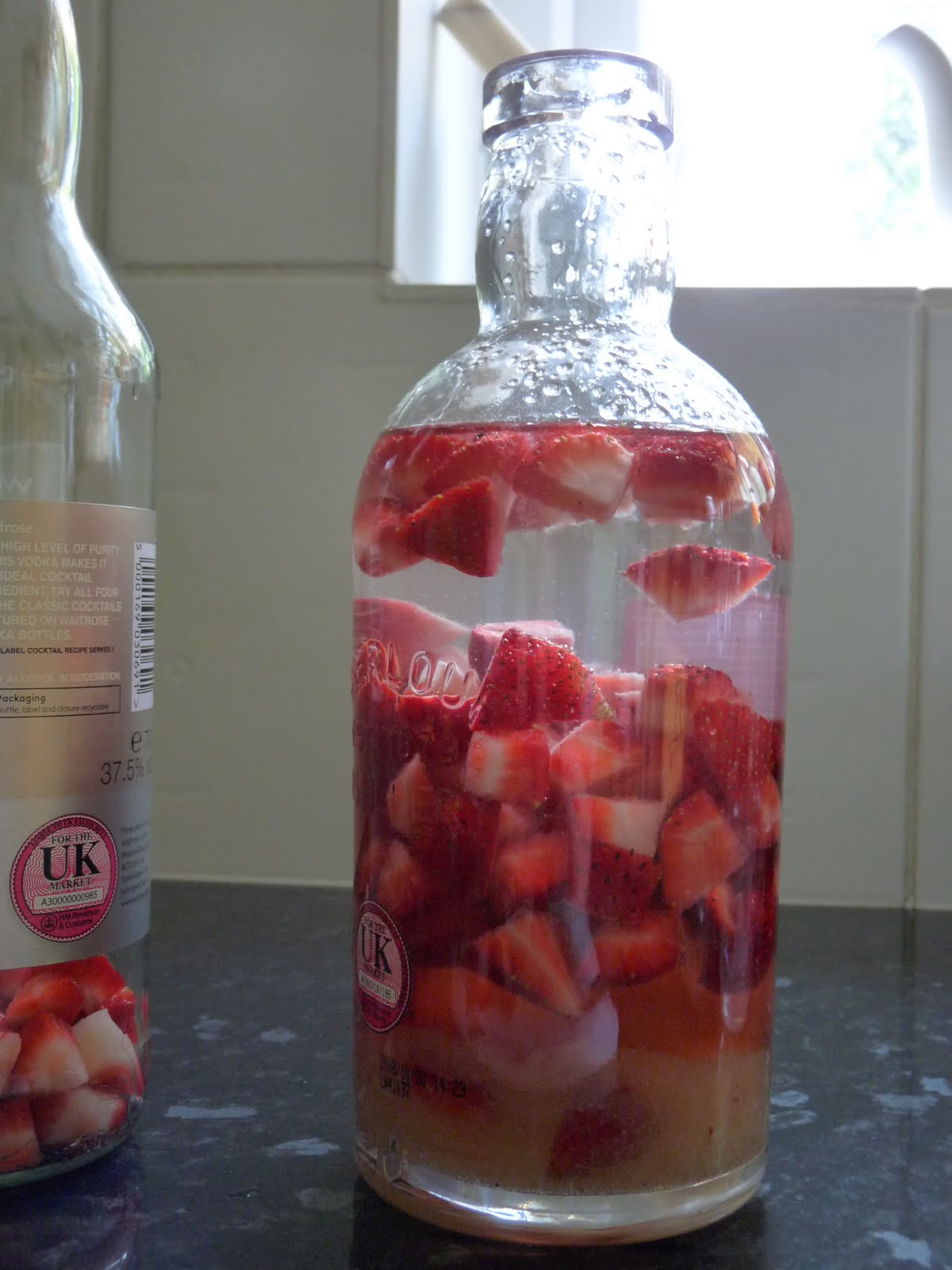
I bought the cheapest 70cl bottle of vodka they had, and some fairtrade golden granulated sugar. At home, I followed the same method as sloe gin, but cutting the strawberries up into eighths rather than pricking each one with a darning needle(or was it a bodkin?!) (that was the family tradition for sloes - the needle gauge was very specific!). I filled a bottle up to halfway with the chopped strawberries, then poured in the sugar and shook it around a bit until the sugar reached about the same level of the strawberries. I then topped up with vodka, added half a vanilla pod (on a whim that strawberry and vanilla vodka sounded like a good combination), shook everything up by gently tipping the bottle up and down, then popped it into the bottom drawer to mature for several months.
To make two bottles, you will need:-
A 70cl and a 35cl bottle of cheap vodka
250g sugar
400g fresh ripe strawberries
1 vanilla pod, cut in half crossways
Give it a gentle shake every week or so. I'm expecting to have to strain it after it's matured, probably through a tea strainer will do, although if you want to get rid of any hint of rusticity, you'll want to strain it through something finer like muslin cloth. I'll keep you posted about how it turns out ...
Subscribe to:
Posts (Atom)